
 About Us
Airflow Meters and Airflow Meter Hardware: Comprehensive Diagnostics for Ventilation Control
Quick Answer: Ventilation control systems need airflow meters that output live signals and tolerate dust, heat, and humidity. Silver Automation Instruments supplies thermal mass and vortex airflow meters with 4-20 mA HART, RS485 Modbus, and local display options. Send us your pressure (bar), temperature (°C), pipe size (DN), and flow range for a matched model and price.
Airflow measurement in ventilation control often fails because the meter hardware does not match the installation. A duct mounted thermal mass flow meter works well for low velocity air in large ducts. A vortex flow meter works better for compressed air or high velocity process air. The correct output wiring and diagnostic setup matters just as much as the sensor. In practice, many sites install a meter and then ignore the diagnostics. That is where flow total errors and fan control problems start.
Why Ventilation Control Needs Reliable Airflow Meters
Ventilation control covers tunnel airflow, sewage treatment aeration, paint booth supply air, combustion air to burners, and cleanroom pressure control. Each application has a different velocity range. A wastewater plant in Saudi Arabia may need to measure 0 to 30 m/s in a 200 mm pipe. A power plant may need to monitor 0 to 10 m/s in a 1.2 m duct. If the flow meter range does not fit the actual velocity, the 4-20 mA signal sits near zero or saturates at 20 mA. The PLC then gets wrong data and fan speed drifts.
Airflow Meter Hardware That Survives Industrial Sites
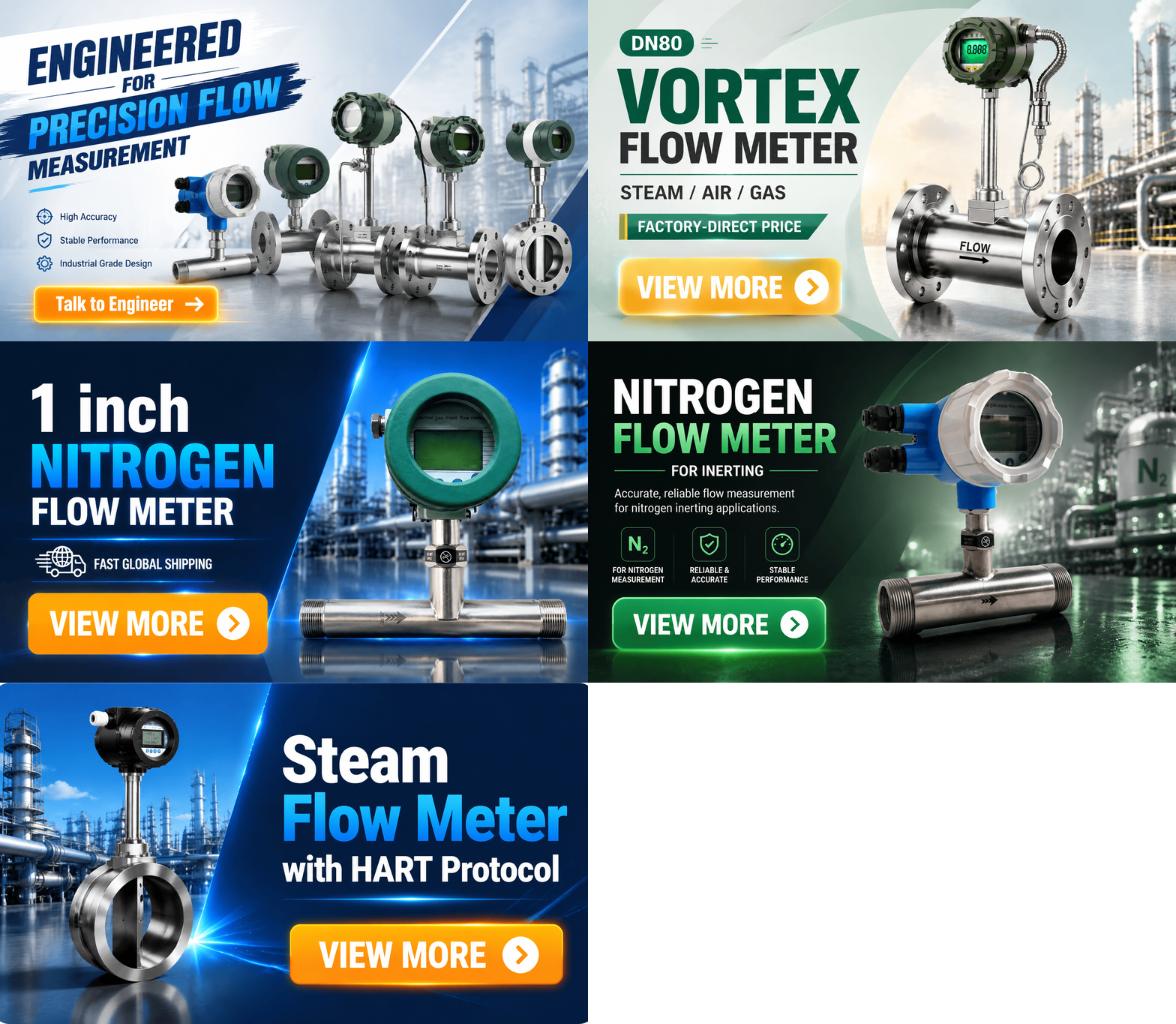
We have seen on customer sites many times that the probe type matters more than the brand. Insertion thermal mass probes work in rectangular ducts and large round ducts. They can be installed through a valve without shutting down air supply. Inline thermal mass meters fit DN15 to DN100 pipes for compressed air or nitrogen. For dirty air streams, consider a vortex flow meter with a bluff body that handles particles better. PT100 sensor elements inside thermal mass probes give stable temperature compensation. For hazardous areas, request ATEX Zone 1 or Zone 2 certification. The electronics housing should be IP65 or IP67 in wet or outdoor locations.
Diagnostics and Signals for Ventilation Systems
Most engineers skip this part. A ventilation system is not just about air speed. The meter has to report diagnostics such as sensor drift, overrange, and temperature limit. Silver Instruments airflow meters provide 4-20 mA HART and RS485 Modbus. The HART signal lets a technician check total flow, velocity, temperature, and alarm status from the control room. The local display shows flow in m3/h, kg/h, or m/s. Because many sites in Southeast Asia have high humidity, the electronics housing needs sealed cable glands. In a tunnel or outdoor installation, choose a meter rated for water ingress and wide temperature swings.
Choosing Between Thermal Mass and Vortex for Air
Thermal mass airflow meters measure mass flow directly. They work well for low pressure air and large duct ventilation. Vortex meters need a minimum velocity and are better for compressed air above 10 m/s. Last year a customer in Vietnam asked us about a compressed air flow meter. We recommended a vortex flow meter with integrated pressure and temperature compensation. It replaced a portable clamp on tester that could not justify the plant air cost allocation. For ventilation air in a paint booth, we supplied a thermal mass flow meter with a 250 mm insertion probe. The plant wired the 4-20 mA signal to a PLC and used it to control fan speed.
Installation Details That Affect Accuracy
Straight upstream piping is the first thing we check. For a vortex meter, keep 15 DN straight run upstream and 5 DN downstream. For an insertion thermal probe, install the probe at the point of average velocity. Avoid elbows, dampers, and branches within the flow conditioning zone. If the duct is rectangular, place the probe one third the way across the short side. If the air temperature changes rapidly, request a meter with fast response. In practice, a 2 second response is enough for most ventilation loops. For environmental compliance, the meter may need a totalizer. Ask for pulse output or Modbus totalizer.
Cost and Lead Time for Airflow Meters
Typical lead time for a standard inline thermal mass airflow meter is 7 to 15 days. Insertion probe models for large ducts take 10 to 20 days depending on probe length and certification. Price depends on pipe size, output, display, and hazardous area requirements. A basic inline meter for DN50 compressed air can start below USD 900. An insertion thermal mass meter with ATEX Zone 2 and HART may run several thousand USD. Send us your pressure in bar, temperature in °C, pipe size in DN, and flow range in m3/h or kg/h. We will return a quote with model selection and a dimensional drawing.
How Silver Automation Instruments Supports Your Project
Silver Automation Instruments supplies and calibrates airflow meter hardware for ventilation control projects across Southeast Asia, Oceania, Latin America, Africa, and the Middle East. We provide wiring diagrams, Modbus register maps, and HART DD files. For distributors, we offer neutral packaging and technical training. For end users, we can arrange factory acceptance testing before shipment. Contact us by Tel: +86-25-68650347 or WhatsApp: +86-25-52155837. WeChat: +86 15365082610. Mention your gas composition if it is not clean air, because thermal mass meters require the actual gas properties for calibration.
FAQ
What airflow meter do I need for a rectangular ventilation duct? An insertion thermal mass flow meter is usually the best choice. Provide duct width, height, air temperature, and velocity range. We will size the probe length.
Can I measure very low air velocity in a tunnel? Yes. Thermal mass flow meters can measure down to 0.1 m/s in some cases. Specify the minimum velocity during quotation so the transmitter range is set correctly.
Does the airflow meter include a local display? Most Silver Instruments airflow meters offer an optional local display. It shows flow, velocity, temperature, and total in engineering units.
Which output works best for ventilation control? 4-20 mA HART is common for PLC and DCS loops. RS485 Modbus is better when you need totalizer, alarms, and diagnostic data on a network.
Can you supply airflow meters for ATEX Zone 1? Yes. Tell us the gas group and temperature class. We provide ATEX Zone 1 or Zone 2 certification for thermal mass and vortex meters.
 Contact Us
 Related AD